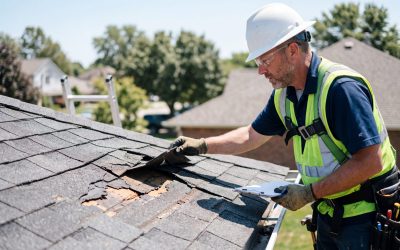
Commercial roof leaks often appear far from their actual source because water can travel beneath the roof surface before it reaches a visible interior finish. Moisture may move along insulation, decking, structural members, membranes, or other building components, making the ceiling stain an important clue but not necessarily the exact location of the roof opening.
For property owners and facility managers, this is one of the most important things to understand about leak diagnosis. Repairing the roof directly above an interior stain may fail if water actually entered somewhere else and traveled through the assembly before becoming visible.
Why Doesn’t Water Always Drip Straight Down?
Water follows the easiest available path.
After entering through a roof defect, it may encounter sloped decking, insulation, framing, membrane layers, mechanical supports, or other materials. Instead of immediately dripping into the space below, moisture can move laterally or downslope.
The path may be short, or it may extend well beyond the original entry point.
This is why an interior stain should generally be treated as evidence of water intrusion rather than a precise map of the roof defect.
Federal roofing guidance recognizes this challenge. The U.S. Department of Defense’s roofing guidance states that the first phase of repairing moisture infiltration is accurately identifying and locating the source, and notes that this process can range from straightforward to complex depending on the circumstances.
That distinction is especially important on large commercial buildings, where the roof assembly may cover thousands of square feet and contain many possible water-entry details.
What Can Water Travel Along Inside a Commercial Roof?
The exact path depends on how the roof and building are constructed.
Possible routes include:
- Roof decking
- Insulation
- Structural framing
- Membrane layers
- Fasteners and penetrations
- Mechanical supports
- Interior ceiling systems
- Adjacent wall assemblies
Some roof systems contain multiple layers, which can make the path even more difficult to interpret from inside the building.
For example, water may enter through a membrane opening, move within insulation, and eventually reach a deck joint several feet away. It may then follow that joint before dripping onto a ceiling tile.
The visible damage might therefore develop nowhere near the original membrane opening.
Can the Leak Source Be Outside the Roof Itself?
Yes.
Not every moisture problem reported as a roof leak actually begins in the roof covering.
Federal roofing guidance specifically warns that interior moisture infiltration can result from defects in nearby walls, windows, mechanical units, or other adjacent building systems.
That creates another diagnostic challenge.
Suppose moisture appears below a section of roof containing an HVAC unit. The source might involve:
- Roof curb flashing
- A membrane seam
- A penetration
- Mechanical equipment
- Condensate
- An adjoining wall
- Another nearby roof detail
The fact that all of these possibilities exist is why commercial roof inspection is more useful than simply assuming the wettest-looking roof area caused the leak.
Why Can Flat and Low-Slope Roofs Be Difficult to Diagnose?
Many commercial buildings use flat or low-slope roofing systems.
Although these roofs are designed to drain, the water path can be less visually obvious than on a steep roof where runoff consistently moves toward an eave.
Low-slope roofs also contain numerous details that interrupt the broad membrane surface, including:
- Roof drains
- Scuppers
- Curbs
- Vents
- Pipes
- Parapets
- Expansion joints
- Seams
- Flashing
- Equipment supports
Any of these areas may become part of a leak investigation.
The challenge is not simply finding a visible defect. The inspector needs to determine whether that defect actually corresponds to the interior moisture being investigated.
A roof may contain an old patch or minor surface imperfection near a stain without that condition being the active source.
How Do Roof Inspectors Work Backward From an Interior Leak?
Leak diagnosis often begins inside the building.
The interior symptom can be documented and measured relative to recognizable building features. From there, the corresponding exterior roof area can be located and inspected.
Federal roofing guidance specifically recommends locating interior leak damage using a reference point and correlating that location with the roof above. If an obvious roof defect is not present there, nearby building components should also be investigated.
This process can involve examining:
- Membrane seams
- Flashing
- Roof penetrations
- Equipment curbs
- Parapet transitions
- Expansion joints
- Drains and drainage paths
- Previous repairs
The investigation then expands outward if the likely source is not immediately clear.
This is why good leak diagnosis resembles troubleshooting rather than simply finding the nearest visible crack.
Why Can Testing Start Below the Suspected Leak Area?
Controlled water testing sometimes works from lower roof or wall areas toward higher ones.
That sequence is important because water applied to an upper section may wash over lower components before an interior leak appears.
If the lower components were never tested independently, it may be impossible to determine which part actually allowed the water inside.
Whole Building Design Guide guidance on controlled spray testing specifically recommends beginning at the lowest suspected area and progressing upward. It explains that this method helps isolate the actual point of water entry.
This illustrates an important principle of commercial roof leak repair: diagnosis needs to isolate the source rather than merely reproduce the symptom.
Can Wet Insulation Make the Leak Location More Confusing?
Yes.
Once water reaches insulation beneath a roof membrane, moisture can spread beyond the original opening.
Depending on the insulation type, roof configuration, and amount of water involved, the wet area may extend farther than the entry point.
This can create several complications.
First, moisture may later drip into the building at multiple locations.
Second, an interior stain may appear after the rain has already stopped.
Third, the wet area may make it difficult to infer the membrane breach using interior symptoms alone.
Testing technologies can help in certain circumstances. Federal building guidance identifies methods such as infrared thermography, capacitance testing, and electronic leak detection for evaluating moisture or breaches beneath roofing and waterproofing systems.
These techniques are tools, not automatic answers. The results still need to be interpreted in relation to the roof assembly and visible conditions.
Why Might a Leak Show Up Only During Certain Storms?
A roof defect may not leak under every rainfall condition.
Wind direction, rainfall intensity, duration, drainage, and water depth can all influence whether water reaches a vulnerable opening.
For example, a flashing condition on the side of a rooftop curb may stay dry during light vertical rainfall but admit moisture when wind pushes water toward that transition.
Likewise, a drainage issue may not become evident until enough rain falls for water to accumulate in a low area.
For facility managers in Glendale and the broader Phoenix metropolitan area, documenting the weather conditions associated with each leak can provide valuable diagnostic information.
Useful notes include:
- Whether wind was strong
- Which direction the storm approached from
- How long the rain lasted
- Whether the leak appeared immediately or later
- Whether the same interior location leaks every time
Patterns can help narrow the investigation.
Why Can Repeated Repairs Miss the Actual Problem?
The simplest explanation is that the repair may have addressed the symptom instead of the source.
Consider a ceiling stain located below a membrane seam.
If the seam directly above the stain is sealed but water actually entered through flashing several feet upslope, the repair may appear successful during light rain while the original problem remains.
The next significant storm could produce the same stain again.
Repeated patching around the same interior location is therefore a signal that the diagnostic assumptions may need to be reconsidered.
A company evaluating Commercial roof repairs should be looking at possible water paths, nearby transitions, roof penetrations, and surrounding components rather than relying only on where moisture became visible indoors.
What Roof Areas Commonly Deserve Attention During Leak Diagnosis?
There is no single component responsible for all commercial roof leaks.
However, transitions deserve careful attention because they interrupt the continuity of the roof surface.
Membrane Seams
Seams connect adjoining roofing materials.
If a seam opens, separates, or becomes damaged, water may reach the layers underneath.
Flashing
Flashing helps manage water around walls, edges, curbs, penetrations, and other transitions.
A flashing issue can sometimes produce symptoms far from the actual defect.
Rooftop Equipment Curbs
HVAC equipment and other rooftop units often sit on curbs that require waterproof transitions to the surrounding roof.
Both roofing and mechanical conditions may need to be considered when moisture develops nearby.
Penetrations
Pipes, vents, conduits, and other penetrations create interruptions in the roof membrane.
Their flashing or sealing details should remain integrated with the surrounding roof system.
Parapet Walls
The connection between a low-slope roof and a parapet includes several possible water-management details.
Water entering higher on a wall may also travel before reaching the interior.
Drains and Scuppers
Drainage components can influence where water accumulates and which roof areas receive prolonged exposure.
The presence of water near a drain does not automatically mean the drain itself is leaking.
Does One Interior Leak Mean the Whole Commercial Roof Is Failing?
No.
A leak identifies a problem that needs investigation, but it does not automatically determine the scope of the repair.
The source could be highly localized.
Examples might include a small membrane puncture, one flashing defect, a damaged seam, or a problem around a single penetration.
On the other hand, multiple leaks, widespread moisture, deteriorated roofing materials, or repeated repair failures may indicate a broader condition.
That difference should be established through inspection rather than assumption.
A commercial roof repair company may recommend localized work when the surrounding system remains serviceable, while more widespread conditions could justify a different plan.
The presence of water alone does not determine which option is appropriate.
How Can Facility Managers Make Leak Diagnosis Easier?
Good documentation can save time.
When a leak occurs, record:
- Exact interior location
- Date and time
- Weather conditions
- When dripping began
- How long it continued
- Whether the leak has happened before
- Previous roofing or HVAC work nearby
- Photographs of stains or active water
Do not remove damaged ceiling materials before documenting them unless safety or building operations require immediate action.
It can also be useful to identify fixed reference points inside the building, such as columns, walls, doors, or equipment locations.
These landmarks can help correlate the interior symptom with the roof above.
Should Facility Staff Walk the Roof Looking for the Leak?
Roof access should be handled carefully.
Commercial roofs may contain slippery surfaces, fragile areas, trip hazards, unprotected edges, skylights, equipment, and other hazards.
There is also a risk of damaging membranes through unnecessary foot traffic.
Federal roofing guidance stresses that roof repair work requires appropriate personnel, fall-protection procedures, and safe work practices.
Facility staff can often provide more value by documenting interior conditions and recent building activity than by attempting to diagnose the roof themselves.
If safe roof access is already part of their job responsibilities, observations should still be limited to what they are trained and authorized to evaluate.
Why Does Leak History Matter?
A single leak is one data point.
Several leaks over time can reveal a pattern.
Maintenance records may show that moisture repeatedly develops:
- Near the same roof penetration
- After wind-driven rain
- Following HVAC work
- During prolonged storms
- In several areas along the same parapet
- Around a recurring seam condition
That history can help distinguish an isolated event from a chronic problem.
It may also reveal whether previous commercial roof repairs corrected the source or only provided temporary relief.
Documentation is especially helpful when different contractors or facility managers have been involved over the life of the building.
What Happens After the Source Is Found?
Once the likely entry point has been identified, the surrounding roofing system still needs to be evaluated.
The visible breach may be small, but the affected area underneath could be larger if water has spread into insulation or other components.
The repair scope may therefore consider:
- The membrane or roof surface
- Flashing
- Wet insulation
- Substrate condition
- Nearby seams
- Adjacent penetrations
- Previous repairs
- Drainage
The objective is to restore the affected roof detail while addressing materials that may have been compromised by water.
The appropriate approach depends on what the inspection finds.
Why Accurate Diagnosis Matters More Than the First Visible Clue
Commercial roof leaks can be deceptive because the building often reveals the effect of water long after and far away from the point where it entered.
A stained ceiling tile may identify the general area of concern, but it should not be treated as proof that the roof directly above it contains the defect.
Water can travel through roofing assemblies, insulation, decking, structural elements, and adjacent building components. The leak may also involve a wall, mechanical unit, flashing transition, or another feature near the roof.
For Glendale property owners and facility managers, the most useful response is a methodical one: document the symptom, correlate the interior and exterior locations, evaluate likely roof details, and expand the investigation when the obvious location does not explain the moisture.
That process gives commercial roof inspection and repair work a much better chance of addressing the actual source instead of repeating the same patch in the wrong place.